FireLizard IT | Web | AI Solutions {thefirelizard.com}

Agentic AI & RAG Workflows: Inside the Chatsistant Engine

Behind the Build: Why FireLizard Created Chatsistant

Discover how our agency solved the "thin wrapper" crisis by building an enterprise-grade AI orchestration framework from the ground up.

The AI gold rush is in full swing. Everyone is rushing to build apps and deploy simple chatbots. However, the reality is that 90% of them will vanish the moment big tech companies update their native features. Why? Because most developers are building fragile "Thin Wrappers."

At FireLizard, our development team designs architecture that lasts. We needed a robust framework to power the complex automation workflows, custom web builds, and backend CRM systems we deploy for our agency clients. When we looked at the market, the available tools fell short. So, we built our own AI baby.

Enter Chatsistant.

Escaping the Wrapper Trap

A thin wrapper is like buying a pre-made car engine and putting a shiny piece of plastic over it. You go to the app simply because you want basic AI power. If the company that made the core engine decides to release their own interface, your business is instantly obsolete.

We refuse to build obsolete systems for our clients. Instead of just adding a chat box to a website, we engineered Chatsistant as a Deep Orchestration Wrapper. It gives us a secure environment to connect multiple specialized tools. It allows us to manage state, define conditional routing, handle complex data payloads, and execute custom function calling.

When you partner with FireLizard for a custom build, you are not just getting a web design. You are getting the exact same elite engineering team that architected an entire AI platform.

Agentic AI and The Supervisor

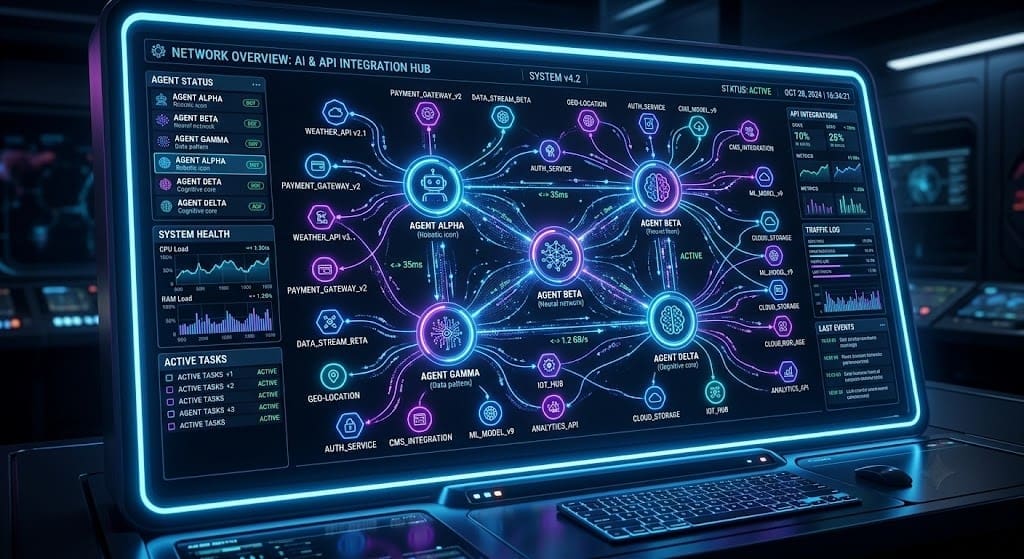
True automation requires multiple digital brains working together. Chatsistant is built on a multi-agent framework where specialized AI agents talk to each other seamlessly.

Deep RAG Workflows

Retrieval-Augmented Generation (RAG) is what makes an AI actually smart about your specific business. Instead of relying on general internet knowledge, we use Chatsistant to securely embed your proprietary company data into the logic flow. This ensures the AI provides highly accurate and context-aware responses without hallucinating.

The AI Supervisor

The real magic happens with the AI Supervisor. This built-in system acts as the central brain. It detects user intent and routes traffic perfectly. We have full control to map out exact conversational flows, adjust routing bias, and ensure that specific queries always hit the right specialized agent. Furthermore, by utilizing a Bring Your Own Key (BYOK) model, we keep operational costs entirely within your control.

Interactive Architecture Scale

Slide the bar to see the evolution of AI infrastructure.

Level 1 (The Thin Wrapper) A basic chat interface connected to an API. Highly vulnerable to market changes.

The FireLizard Ecosystem Advantage

Chatsistant stands out in a crowded market because it bridges the gap between affordable accessibility and enterprise functionality. While tools like Watermelon focus strictly on massive customer support volume and Site2CRM focuses entirely on pipeline data, Chatsistant handles the heavy lifting of multi-platform integration.

By leveraging Make.com, Zapier, and n8n alongside robust webhook connections, we configure completely custom automation pipelines. We do not just give you software. We engineer the exact workflow you need to dominate your industry.

Build With The Architects

Do not trust your digital infrastructure to an agency that relies entirely on fragile third-party tools. Partner with the team that builds the core frameworks.

Explore Chatsistant

Featured Posts

Subscribe to Newsletter

Leave a Reply

Your email address will not be published. Required fields are marked *

Picture of FireLizard

FireLizard

IT | Web | AI Solutions

Featured Posts

Subscribe to Newsletter

Transforming Challenges into Opportunities

Starting with application code built for a specific CMS, the process of transforming it to CMS-agnostic is what, in this article, I will call “abstracting code”. The more abstract the code is, the more it can be re-used to work with…

Read More »

In-Depth Industry & Ecosystem Analysis

Starting with application code built for a specific CMS, the process of transforming it to CMS-agnostic is what, in this article, I will call “abstracting code”. The more abstract the code is, the more it can be re-used to work with…

Read More »

How To Use FOMO To Increase Conversions

Starting with application code built for a specific CMS, the process of transforming it to CMS-agnostic is what, in this article, I will call “abstracting code”. The more abstract the code is, the more it can be re-used to work with…

Read More »

5 Questions for Connected Product UX

Starting with application code built for a specific CMS, the process of transforming it to CMS-agnostic is what, in this article, I will call “abstracting code”. The more abstract the code is, the more it can be re-used to work with…

Read More »

Ways To Manage Content In WordPress

Starting with application code built for a specific CMS, the process of transforming it to CMS-agnostic is what, in this article, I will call “abstracting code”. The more abstract the code is, the more it can be re-used to work with…

Read More »

Top Mobile App Development Companies

Starting with application code built for a specific CMS, the process of transforming it to CMS-agnostic is what, in this article, I will call “abstracting code”. The more abstract the code is, the more it can be re-used to work with…

Read More »

Unique Mobile App Ideas for Your Startup

Starting with application code built for a specific CMS, the process of transforming it to CMS-agnostic is what, in this article, I will call “abstracting code”. The more abstract the code is, the more it can be re-used to work with…

Read More »

The Future of API Development

Starting with application code built for a specific CMS, the process of transforming it to CMS-agnostic is what, in this article, I will call “abstracting code”. The more abstract the code is, the more it can be re-used to work with…

Read More »

How to Get Visitors to Love Your Brand

Starting with application code built for a specific CMS, the process of transforming it to CMS-agnostic is what, in this article, I will call “abstracting code”. The more abstract the code is, the more it can be re-used to work with…

Read More »

How Much Does a Site Cost to Build?

Starting with application code built for a specific CMS, the process of transforming it to CMS-agnostic is what, in this article, I will call “abstracting code”. The more abstract the code is, the more it can be re-used to work with…

Read More »

Content Ideation: Tools & Techniques

Starting with application code built for a specific CMS, the process of transforming it to CMS-agnostic is what, in this article, I will call “abstracting code”. The more abstract the code is, the more it can be re-used to work with…

Read More »

How to Use the Mobile App Typography?

Starting with application code built for a specific CMS, the process of transforming it to CMS-agnostic is what, in this article, I will call “abstracting code”. The more abstract the code is, the more it can be re-used to work with…

Read More »

Augmented Reality Platform By Google

Starting with application code built for a specific CMS, the process of transforming it to CMS-agnostic is what, in this article, I will call “abstracting code”. The more abstract the code is, the more it can be re-used to work with…

Read More »

Native App vs Hybrid Mobile App

Starting with application code built for a specific CMS, the process of transforming it to CMS-agnostic is what, in this article, I will call “abstracting code”. The more abstract the code is, the more it can be re-used to work with…

Read More »